

Human Judgment in the Age of AI
Asking what AI can do, and what human beings must still develop.
I am focused on the conditions under which human judgment does not merely survive contact with increasingly capable systems, but becomes stronger, more legible, and more accountable through the mindset we adopt when we collaborate with AI. That means resisting the easy confusion between fluency and thought, between output and ownership, and between acceleration and actual capability. It means asking what AI can do, and what human beings must still develop, apply, and stand behind if judgment is to remain genuinely theirs.
At the centre of this architecture sits The Cognition Ignition Wheel™, which organises five interdependent domains through which human judgment can be developed, applied, and made accountable in the age of AI.
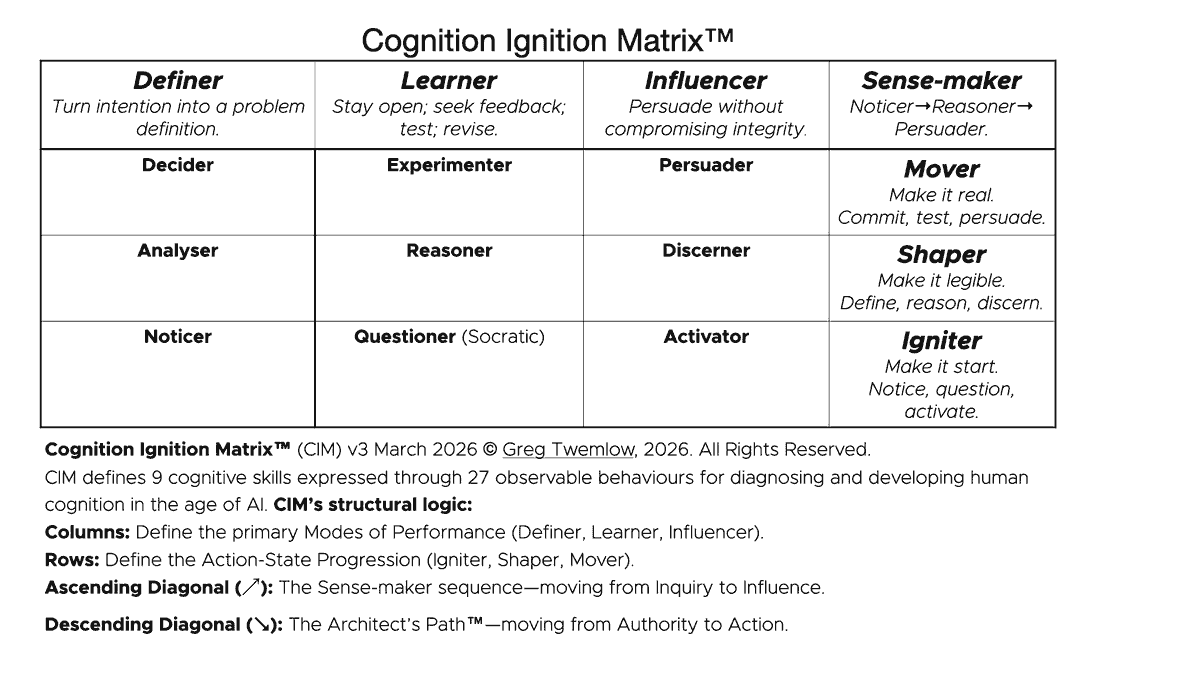
At the core of that wheel sits my Cognition Ignition Matrix™ framework. The Matrix is the 9-cell diagnostic and developmental instrument that makes cognition more visible within the architecture of the Wheel. It is designed to help individuals, leaders, and organisations recognise the forms of thinking that matter most when synthetic fluency is abundant, and to distinguish genuine capability from its appearance.
In that sense, the Matrix functions as a diagnostic and a developmental artifact. It helps surface the cognitive behaviours that must be cultivated if human beings are to remain present in the decisions, recommendations, and contributions that increasingly unfold in partnership with AI.
The 9-cell Matrix (see below) helps reveal whether a person or team is merely producing fluent output or actually exercising the underlying cognitive roles required for accountable judgment. A leader may appear decisive, for example, while the Matrix reveals a deficit in questioning, discernment, or evidence-testing. A student may produce a polished presentation, while the Matrix shows that the visible output outran the cognitive struggle required to truly own it. The value of the instrument lies in making those hidden strengths and weaknesses legible enough to develop.
Around that centre, five interdependent domains sit.
Why this architecture matters
These five domains are distinct, but they are not isolated. They are also not meant to operate synchronously. The wheel is designed to reflect an asynchronous reality in which different domains may carry more weight at different moments, while still remaining interdependent through the same governing centre.
Personal Agency without Cognitive Capability becomes intention without strength. Experiential Cognition without productive difficulty can produce polished performance without durable formation. Creative Thinking without discernment can mistake fluency for contribution.
Use the Contact Form to get in touch.
Cognition Ignition: Reclaiming Agency in the Age of AI
In an era of automated fluency, professionals face the rising tide of "automated genericism"—a state in which AI-generated output is "plausible" but lacks the ethical nuance and situational context essential for high-stakes decision-making. To survive this shift, we must transition from being spectators of the AI revolution to becoming Discerner Architects©.
A Discerner Architect intentionally designs their own cognitive workflows, treating discernment as a formal discipline to ensure that human accountability remains the primary processor. The cornerstone of this defence is the Sovereign Moat: a fortified perimeter of human judgment. Building this moat is not about rejecting technology, but about ensuring that as AI accelerates our perception, it never overrides our ethics or our accountability.
The Framework: The Cognition Ignition Matrix™ (CIM)
The structural foundation of the moat is the Cognition Ignition Matrix™ (CIM)—a 3x3 geometric grid that organises cognitive labour into nine distinct, timeless skills. While technical skills (like coding or financial analysis) change with the tools of the era, architectural skills are the foundation of human judgment.
The Matrix is divided into three functional categories:
The Igniters (Noticer, Questioner, Activator): These protect the Inception of a thought, preventing the machine from suggesting the problem you should solve.
The Shapers (Analyser, Reasoner, Discerner): These protect the Integrity of the thought. At the centre is the Reasoner, the Human CPU, which validates the link between evidence and implication.
The Movers (Decider, Experimenter, Persuader): These protect the Outcome, ensuring you retain agency over real-world results.
The math of this matrix reveals 255 possible configurations for your moat, allowing you to align your defence with your unique career goals and professional identity. For many, the 5-Cell Moat offers a state of equilibrium, mirroring the mathematical balance of Euler’s Identity, (e^(i*π) + 1 = 0), by grounding complex variables into a stable basis of human accountability.
The Practice: A 7-Step Protocol for Sovereignty
Transitioning from theory to architecture requires an iterative, daily discipline called the 7-Step Protocol. This recurring cycle is essential to prevent "machine-drift" and cognitive atrophy.
Comprehend: Internalise asynchronous thinking, recognising that human judgment is a "pivoting engine" that does not follow a machine’s linear sequence.
Contemplate: Define your "Red Lines"—the cognitive territories you refuse to outsource—and identify your Nucleus (anchor value).
Audit: Use the Sovereign Identity Audit to measure your actual behaviour against your intent. The standard is Evidence Over Eloquence: if you haven't performed a skill in 30 days, it's classed as a "stagnant memory," not an active defence.
Reflect: Conduct a strategic interrogation using 9 specific questions to expose machine-drift and verify human primacy through third-party perspectives.
Apply: Use the Context & Critique Rule™ to bridge the gap between AI drift and sovereignty. You establish a "firewall" of context and provide a manual, high-integrity human Alternative to automated output.
Fortify: Build "mental muscle" by performing core cognitive behaviours in Manual Mode, using AI strictly as Cognitive Scaffolding.
Proclaim: The "Hang Your Art" Test. Sovereignty that remains hidden is easily circumvented. You must present your moat as your unique professional value proposition to those you seek to influence.
By adopting the Cognition Ignition protocol, the Discerner Architect stops racing the machine and begins building an architecture that AI can never inhabit.
Read the detailed article on Medium. Use the Contact Form to get in touch.

