

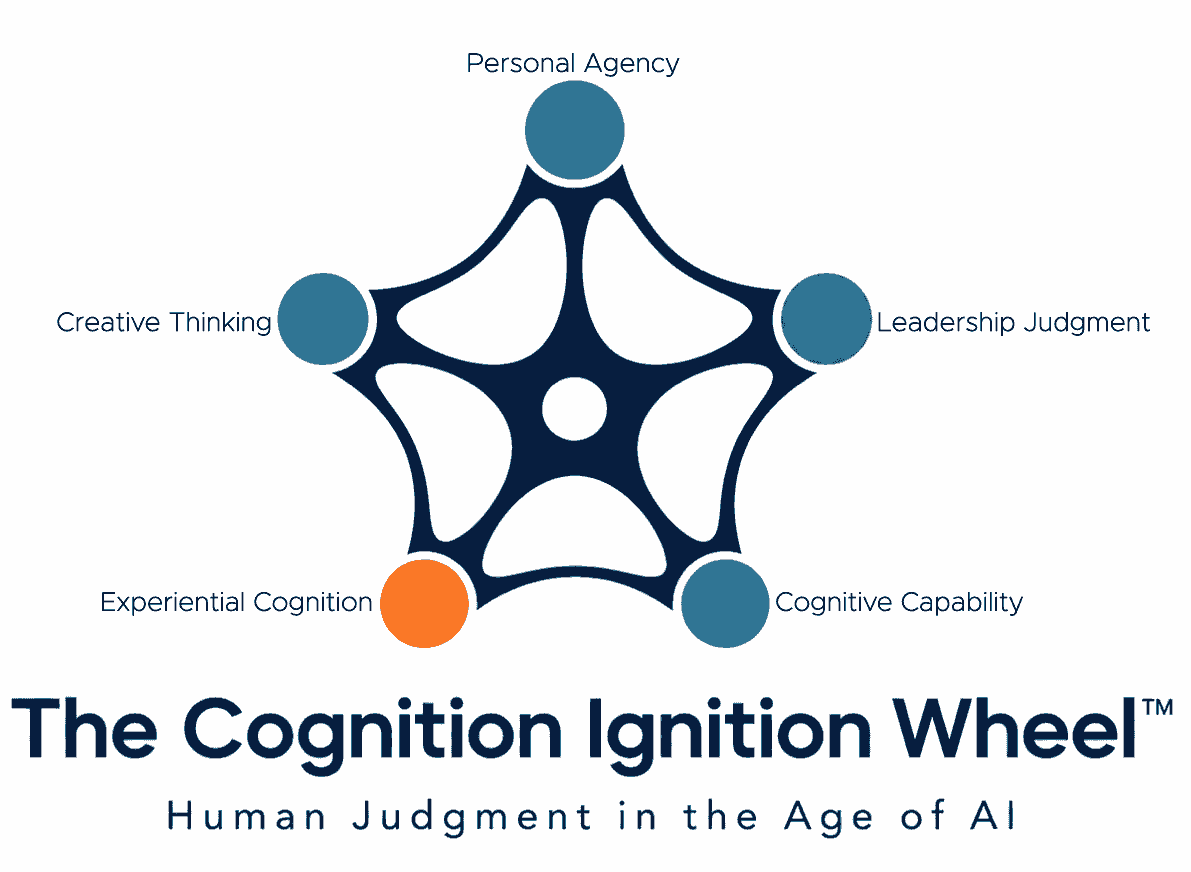
Future-Proofing "Learn by Doing" for the AI Era: A Partnership Proposal for Cal Poly CEI
At its core, Cal Poly's 'Learn by Doing' philosophy relies on a continuous loop of hands-on action and critical reflection. However, the rise of generative AI threatens to hollow out the reflection phase by providing instant, frictionless answers. My pedagogical frameworks, including the Cognition Ignition Matrix™, complement Cal Poly’s mission by providing an auditable architecture for human discernment. By synergizing Cal Poly's experiential curriculum with my cognitive protocols, we close the 'reflection gap'—ensuring students are explicitly trained to govern AI tools, preserve their Agency, and explain authorship of their work.
The Industry Problem: The Hollowing Out of "Perceptually Intelligent Discernment™"
Cal Poly’s corporate partners are facing an invisible crisis. As enterprise AI adoption accelerates, companies are failing to measure the living cognitive capacity of the people making decisions. AI excels at high-volume, low-complexity tasks, but as employees mistake machine fluency for actual thought, they begin to surrender their judgment. This dynamic quietly hollows out the workforce's "Perceptually Intelligent Discernment™"—the accumulated judgment, reasoning, and ethical discernment that lives within the management layer.
The Threat to "Learn by Doing": Employers seek Cal Poly graduates because the historic "Learn by Doing" pedagogy ensures they are workplace-ready. This pedagogy is fundamentally anchored in active engagement and, crucially, self-reflection. However, AI threatens to eliminate the "friction" of critical thinking. If students are allowed to rely on AI to bypass the struggle of reflection, they are no longer "doing"—they are simply "processing". To guarantee that Cal Poly graduates remain the most accountable and high-judgment talent in the workforce, they must "learn by doing" how to govern intelligent systems, not just use them.
The Enterprise Solution: A Formalized Cognitive Architecture
My intellectual property provides a sophisticated, enterprise-grade cognitive architecture designed to protect ethical boundaries, make human judgment visible, and Future-Proof Cal Poly's core brand promise. By integrating these frameworks, CEI can build even stronger, mutually beneficial foundations with its industry collaborators.
--------------------------------------------------------------------------------
🟦 SIDEBAR: The Cognition Ignition Matrix™ (CIM) - Read more.
What it is: The CIM is a 3x3 geometric framework and professional defense structure designed for the AI age. It maps nine human-centric cognitive skills across two axes: how we process value (Definer, Learner, Influencer) and when we take action (Igniter, Shaper, Mover). How it works: At the center of the matrix sits the "Reasoner" (the Human CPU), which audits the link between evidence and implication. The CIM functions as a diagnostic instrument and a sovereignty audit, allowing individuals to clearly see where human agency remains active and where it has unknowingly drifted into machine-dependency.
🟦 SIDEBAR: The Context & Critique Rule™ - Read more.
What it is: This is a disciplined discernment process and cognitive method that protects human authorship against the speed of AI. It is built on a three-step protocol: Evidence → Cognition → Discernment™. How it works: Context is the deliberate act of slowing down to make intent, constraints, and objectives explicit before machine momentum takes over. Critique is the refusal to treat a fluent AI response as self-validating; it is the discipline of testing the machine's output against evidence, ethics, and lived judgment. It ensures that discernment remains human, even when generation is automated.
🟦 SIDEBAR: The Glue – Developing 'Discerner Architects' to Build 'Perceptually Intelligent Discernment™' - Read more.
The unifying outcome: What holds these frameworks together to deliver immense value for Cal Poly students? The ultimate goal is to graduate Discerner Architects. A Discerner Architect is a person who intentionally designs their own cognitive workflows, treating discernment as a formal discipline to ensure human accountability remains the primary processor. By teaching students the Context & Critique Rule via the Cognition Ignition Matrix, Cal Poly protects and builds Perceptually Intelligent Discernment™. This is the "glue" that transforms students from passive consumers of AI into accountable authors of their own work, ensuring they enter the corporate world ready to lead, innovate, and take responsibility for real-world consequences.
--------------------------------------------------------------------------------
A "Win-Win" Call to Action: Proposing a Bounded Pilot
I invite CEI to partner on a low-risk, high-visibility pilot program to demonstrate these frameworks in action, by hosting a faculty seminar and/or delivering my "Impact Blueprint: Innovate Your Future©" workshop for a targeted cohort of students. The pilot will provide immediate, tangible proof of how Cal Poly can operationalize human accountability in the age of AI.
To arrange a phone or video discussion, please email me at: greg@fusionbridge.org or use the Contact Form to get in touch.
